

Greg Wyatt on Faith, Autism, and Finding Purpose Through Pain
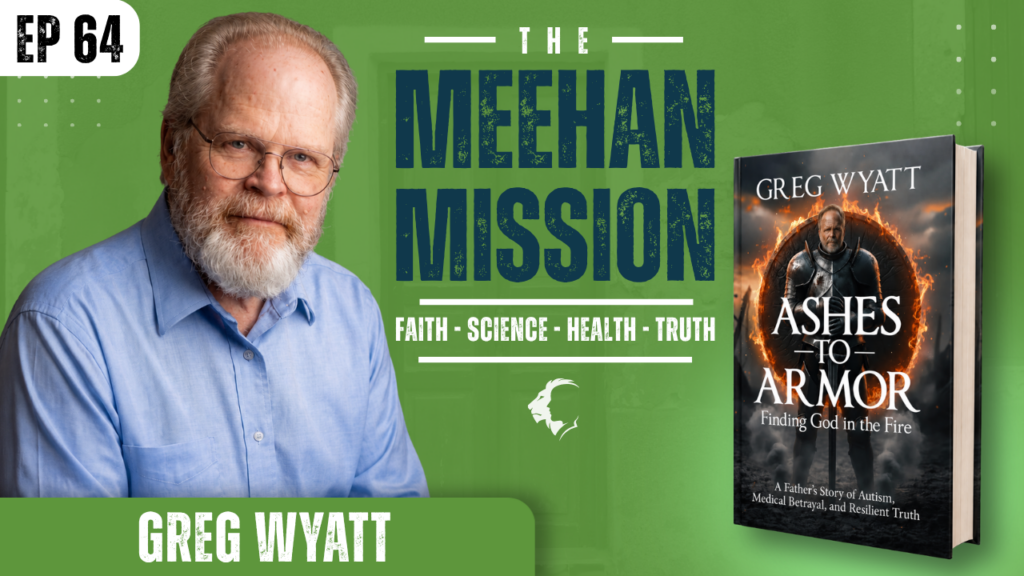
Cathy Meehan: We are not guaranteed a perfect life. In fact, we’re going to have peaks and valleys as we go through our journey. And my special guest today is Greg Wyatt. He’s the author of Ashes to Armor, and it’s his story of his son’s profound autism and what Greg does to maintain the resilience and the strength to get through every day. And not only that, to help others. Get through their lowest times in their life. What we have to realize is just because we are faced with a tragedy, we can overcome that and really fulfill our purpose in life. And this podcast is perfect timing because many of you know that Jim passed away, and it was actually two years ago, yesterday. And we could have taken that tragedy and just curled up in a ball and cried the whole family, the whole clinic. But instead we gathered our thoughts, we used our faith in God, and we have continued on and we are carrying on the Meehan Mission. So today I want to inspire you with Greg’s story. So let’s welcome Greg to the Meehan Mission podcast. Cathy Meehan: Hello, everyone. It’s Cathy Meehan, and welcome to this very special edition of the Meehan Mission Podcast. And I just want to tell everybody I am so excited today to introduce you to Greg Wyatt because Greg is the example of where tragedy happens in your life. And what do we do? We can either wallow in the corner and cry. Or we can take that tragedy and we can turn it into absolutely something beautiful to not only help inspire ourselves, but also to inspire other people that might be going through the same, you know, the same circumstances. So, Greg, thank you for joining me today. And I would love for you to introduce yourself to our community and just let us know, you know, how did you get to where you are now? So let’s hear what you’ve got going on. Greg Wyatt: Only by the grace of God. This hat, I’ve wore, I wear it every day as a reminder of who I am, where I’m at, and where I’m going. This world is just temporary. It’s just a dropping off place to our next destination. So I do wanna thank you for having me on. I’ll do a quick introduction. my name’s Greg Wyatt, and I really wanted to personally thank you. Cathy Meehan: Mm-hmm. Greg Wyatt: For taking the time to join us today. For many years, people have known me through my books, my research, and my business, and of course my advocacy work. Some people know me as a business owner, others know me as an author, some know me as a researcher, and I’ve spent tens of thousands of hours investigating very difficult and often controversial subjects. But most importantly, most people know me as a father, a father to Weston and Emily, a father whose life was changed forever by my children, Weston and Emily. Today, however, I want to do something a little different. I don’t want to talk about headlines. I don’t want to talk about controversies. I don’t want to talk about politics. I want to tell you my story. Because the truth is my story didn’t begin when I became an activist, a businessman, or an author. It began long, long before I was even born. It began with a family secret, a secret connected to America’s eugenics movement, government sterilization programs of humanity, and events that would remain hidden for decades. For most of my life, I believed I knew where I came from. Then one day I discovered that much of what I believed was simply not true. I learned that I’d been conceived through artificial insemination in the 1950s. I learned that my father, Herbert Shorty Wyatt, had been sterilized by the government as part of a eugenics program. And then I began a decades-long search for answers about my origins. My family, and ultimately who this guy is. That journey would take me to places I never imagined. You gotta remember, I’m 70 years old now, and I grew up in a very different America. An America where a man working an ordinary job could build a life, support a family, and dream about the future. Greg Wyatt: I had a fairly good idea on how my life story would unfold. But life and God had other plans. The birth of my son Weston and my daughter Emily brought incredible joy into my life, but they also brought challenges that would ultimately change the direction of everything. Their struggles became my struggles. Their journey became my journey. And what began as a father’s search for understanding eventually grew into a mission that has shaped much of my life over the last decade. That mission led me into years of research, investigation, writing, advocacy, and countless conversations with people from all over the world. And along the way, I witnessed things that inspired me. I witnessed things that broke my heart. I met extraordinary people. I experienced betrayal. I experienced disappointment. And I discovered that some heroes are not always what they appear to be. And I learned that truth is often far more complicated than the stories were told. There were seasons that I felt exhausted. I felt like giving up, and many times I almost did. There were seasons when I felt alone. There were moments when I wondered whether anyone was really listening. Moments when it seemed easier to quit than continue. Yet however every setback became a hidden lesson. Every disappointment became a teacher, and every defeat became another stepping stone forward. If there’s one lesson my life has taught me, it is this. Sometimes your greatest defeats become the foundation of your greatest victories. Now looking back at 70 years of life, I can see that many of those moments I once
Sherry Syence on the Business of Influence and Rethinking Health Messaging
Cathy Meehan: Today, we’re tackling a topic that affects every one of us, whether we realize it or not. It’s the power of messaging and how public opinion is shaped. I like to call it the business of influence. My special guest is Sherry Syence, and she is an award-winning journalist, a media strategist, and the founder of Rethinking Health. Sherry spent her life just helping organizations to really shape their message. Which influences public understanding and hopefully drives change. And today we are going to talk about how some of these health narratives are formed when it comes to advertising and public opinion. We’re specifically going to talk about some organizations like the Ad Council and how other large-scale public awareness campaigns literally changed the way people fall in line like sheep. During COVID, we have to understand that we are impacted by messaging thousands of times every single day. We have billboards, we have television commercials, we have ads that pop up on our computer screen. You might be scrolling through social media and you’re getting all kinds of feeds based on your algorithm. The crazy thing was what happened during COVID, people. How many people literally lined up like sheep, didn’t question the narrative, and went directly to get a vaccination so that they could make everyone else safe. What a lie. What do we need? We need an alternative. We need a place for trusted health resources, and we need to create some critical thinkers out there. Well, that’s exactly what Sherry has done. with rethinking.health. So please let’s get started and let’s welcome Sherry. Cathy Meehan: Hello everyone and welcome to this edition of the Meehan Mission Podcast. And I have my dear special friend Sherry Syence. And Sherry has been in this what I call business of influence for decades. She is the professional to go to and she’s been helping organizations with their messaging, how to get it out, how to influence decisions. So, Sherry, welcome to the show. Sherry Syence: Thanks so much for having me, Cathy. It’s a pleasure to be here with you. Cathy Meehan: Well, I was so excited that you agreed to be on the podcast because, you know, we met during basically during the COVID years and all when all of this advertising’s going on and you see this like message and everyone is like whether fearful or seeking information. But I found it really interesting that people literally were able to be, you know. marched like sheep into lines when it came to getting your COVID vaccination or standing six foot you know distance or wearing a mask. And, you know, this public messaging and these campaigns, why are some of them so effective? What were they doing? Sherry Syence: Well, that’s a great question. And I think each campaign, I’ll call it, is is really different. But when it comes to COVID, I mean, that was a public health emergency. And our government officials worked hand in hand with big tech, online communities, and what I believe was sold. Was fear, right? And that’s really what was a big motivator of getting people to stand six feet apart and to get vaccinated. using fear as the major psychological motivator of the campaign. But it’s a lot more complicated than that. Cathy Meehan: Yes. Cathy Meehan: Yeah. Yeah, it really is. you know, I I feel like they a lot of times, you know, their goal, I guess, was to change people’s minds in whatever direction they were going. And I want to take this to a broader thing of just advertising in general, because really that’s your specialty. Because it seems like advertising’s goal is to get people to change their minds, right? Or get them to going into a a new direction. And What type of things do companies or organizations use when they are trying to change direction of a mind besides things like fear? I mean, give me some background information on exactly how advertising campaigns work. Sherry Syence: Okay, another really good question. And none of them are exactly alike and I like to think of it instead of just advertising messaging as well because it really it’s advertising in messaging and PR that work in tandem to shape behavior and and that is what I realized after spending all of my time in communications in one area or the other. I told you I started out as a broadcast journalist and then I grew up in an ad agency household. My mom had a very big ad agency in the DC area. I spent a lot of time in there. I worked in broadcasting, I worked in her agency, then I went out on my own and started working in corporations and then eventually started my own consultancy. And so whether it’s an ad or whether it’s corporate messaging or a PR campaign, there are underpinnings that drive them all. And it is the messaging. With the ads, most of the ads that we see. Are really designed to drive consumption and to drive certain behaviors, but but predominantly to drive consumption. So, or sales, that’s another thing, but they really go hand in hand. Cathy Meehan: So when you work with an organization, do they typically and I I’m just using this for an example. I know that I am, I have an organization, I have a clinic, and I work with a marketing company and I try to get them to help me sell my product. So they ask me all kinds of questions on like who my audience is, what type of sales I’m, you know, hoping for. and all of these standard, you know, markers and goals and everything. And I have to tell you, it is not that easy when it comes to if you want to call it, you know, creating that message. What types of things do you ask clients when they’re
Chris Downey on VaxCalc, Informed Consent, and Helping Parents Prepare for Well Visits
Cathy Meehan: Hello everyone and welcome to this episode of the Meehan Mission Podcast. I’m your host, Cathy Meehan, and today we’re talking about technology and decision-making skills. Now, if you know me, you know that technology is not my cup of tea, which is exactly why I had to do this episode. My special guest is Chris Downey. He is the founder of VaxCalc. This is a software program where he just helps parents organize and explore all of the options and information that’s out there in regards to the decisions you’re going to need to make when you are visiting your pediatrician. So Chris uses his technical skills as a software developer plus his own personal journey, which actually brought him into this whole arena of informed consent. to make sure that you as a parent have the tools and resources you need to make confident decisions regarding your child’s health. So if you’re a parent, this episode is for you. Let’s get started and let’s welcome Chris to the show. Cathy Meehan: Hello everyone and welcome to the Meehan Mission Podcast. And as promised, I brought Chris Downey back from VaxCalc. Chris, it is great to see you today. Chris Downey: thank you so much, Cathy. It’s great to be here. Cathy Meehan: You bet. Well, really what is so important nowadays is all of the information and the overload and AI when it comes to making informed decisions for parents regarding their children’s health. So Chris Downey: You know, it yeah, that’s that’s an excellent question. You know, it’s for for decades, for decades we’ve been saying that parents need to remain the primary decision makers. But at the same time, there’s you know just an an overload of information, more information. I mean you can do endless research. The thing that’s missing is a decision framework. And that’s what VaxCalc is building and striving to bring to parents. Cathy Meehan: Mm-hmm. Cathy Meehan: Yeah. Well, why don’t we start with what got you involved in the whole world when it comes to health and kids and informed consent? Chris Downey: no, thank you so much. That’s a that’s a really good question. what got me involved? You know, I was just sort of like a geeky software developer. And I never I never thought you know about vaccines or anything. And you know, my wife was pregnant with our first child. This was way back in 2003. Cathy Meehan: Yeah. Chris Downey: And I you know, I we we were talking, we should go around and we we we decided we needed to go and talk to some different pediatricians to see just to find a good fit. And it had nothing to do with like vaccines, no vaccines or anything like that. It was just I just want to find a good fit, someone who I you know, I I often go by the gut. Like do I like this person? Do I not? Do I have a good feeling? Do I not? And so we went around and we talked to like five, six or seven of them. And you know, all of them were great. They were friendly, they were professional, they had nice personalities, they seemed to know what they were talking about. But then whenever the issue of vaccines came up, it something just switched. You know, it was like this kind of wall came down. Or I’d noticed that like their instead of looking right at me, their eyes would kind of look up in a way, almost like they were reading a script in their in their minds. And every single one of them said something strange. And it and it was said in the exact same way that our soon-to-be born daughter would need the hepatitis B vaccine. And when I every time I heard that, you know, I just stopped. I was like, wait a, wait, wait a second. I don’t understand why you would give a baby or even a newborn the hepatitis B shot. I mean, isn’t that the disease you get from sharing dirty needles, sleeping with prostitutes? I mean, I just don’t see this as an issue. You know, what what’s the rationale here? And their answers were always incredibly lame. They had nothing to do with our life. He’s like, well, you know, she, you know, she might get bit in daycare. It’s like, well, but she’s not going to daycare, so you know, that’s not an issue. Right. And they say, well, she might need a blood transfusion. It’s like, well, how much do you have any data you could show me that about the chances she’s gonna need a blood transfusion? I mean, this is starting to sound kind of weird. And they would just tense up as they were trying to give more and more reasons for it. Cathy Meehan: That’s nuts. Yeah. Chris Downey: And one one of them even said, Well, you know, I’ll have to report your refusal. And I’m looking at it, yes, yes. I’m like, wait, I’m not, I mean, I’m not even I’m not even working with you yet. And you’re like, you’re gonna report my refusal. I felt like I was back in eighth grade. I was, you know, I even said, you know, that’s like what an eighth grade teacher would tell me if I refused to do, you know, to do something in the classroom. This is this is kind of weird. Yes, yes, yes. And so, you know. Cathy Meehan: No they did not Cathy Meehan: Oh my. Chris Downey: This experience was bothering me. It was driving me nuts. I was like, what is going on here? There’s something I don’t understand. Something is going on because every single one of them, you know, very different people, different locations, male, female, different races, everything. They all said the same thing. Okay, and yeah. And so I’m
Eric Barber on Fitness After 40 + Why Accountability Changes Everything

Cathy Meehan: There’s something that people begin to notice when they’re in their 40s and 50s and 60s: that, hey, what we did in our 20s and 30s just doesn’t seem to work anymore. We are facing energy changes, recovery changes, our hormones shift, our life just gets so much busier, and we also handle stress differently. On today’s Meehan Mission podcast, I’m joined by Eric Barber, the founder of Barberic Training. I love this episode because he really brings it down to the basics and especially accountability. Not only that, but Eric lets us into his personal journey of where he was five, six years ago at the heaviest he’d ever been. He had stopped working out and he was just spiraling into depression. And it’s very important for people to realize that the best years of your life are not over. And sometimes it just takes that little nudge into getting physically in shape, whether it’s by you know working out and you know dialing in on nutrition. And I will say that I personally went through this journey after Jim’s passing, and it has transformed my life, and it is giving me more energy so that I can carry on my purpose and Jim’s legacy. So please share this episode if there’s people that you know that might be in this same boat. Because I promise you, the best years of your life are yet to come. So please let’s welcome Eric to the show. Cathy Meehan: Hello everyone, it is another edition of the Meehan Mission Podcast, and I have my friend Eric Barber, the founder of Barberic Training. Eric, how have you been? Eric Barber: Yeah, yeah, yeah. Eric Barber: I’m good, I’m good. It’s been a little while, right? It’s normal. Yeah, yeah. I’m a busy dude. Cathy Meehan: It has been a little while, so it’s time to get you back on, definitely. Yeah, well, because you know, I get all kinds of questions when it comes to fitness and health and wellness, and especially from this audience of people who are aging, me included, you know, we’re talking about people in their 30s, 40s, 50s, 60s, and you know, we just don’t train. or lose weight or build muscle like we did when we were 25. So I thought, who better to bring on than Eric Barber so we can talk about, you know, why fitness is getting so much harder as we age. So what’s going on? Eric Barber: Ha ha. Eric Barber: Yeah. everything changes as we get in the forties, fifties, sixties. And I used to I used to really fight that idea. I used to tell people when I was young, when I was in my twenties and thirties, and older folks would tell me that as I was coaching them, I told them that they were wrong and come to find out I was wrong, you know. things definitely slow down. I heard or or read that Cathy Meehan: Mm-hmm. Eric Barber: When you get to the age of 35, I think it is, you stop going up and you start cresting and then you start coming down. meaning that things aren’t on just on a constant growth. They stabilize and then they start to decline. So that shows up in so many areas, of course, recovering from workouts, recovering from injuries, all kinds of things. So yeah, this is a this is a very important subject and something that I deal with all the time. Cathy Meehan: Mm-hmm. Eric Barber: Since most of my clients are in their forties, fifties, and sixties. Cathy Meehan: Mm-hmm. Cathy Meehan: Well, I you know, I can I’m gonna admit to everyone that when I was in high school, my diet gosh, people, it was Doritos and Snickers and Diet Dr. Pepper and Shakey’s pizza and hamburgers. And I don’t go anywhere close to those now. So I know that it there’s definitely an effect on my body as far as like, you know, changes and nutritional requirements. absolutely for sure. So where do you start when you are actually trying to help someone that is aging? And how do you start a whole new Eric Barber: Yeah, just Eric Barber: Yeah. Cathy Meehan: workout program what what do we do? Eric Barber: The first thing I always do is I just ask a series of questions to try to find out what their situation is. You know, everybody, you can’t just lump everybody up in the same category, right? So the first thing I do is I try to get people talking about themselves and I I ask pinpoint questions on, you know, how how what their medical situation is like. Do they have any injuries, either lifelong injuries, chronic injuries, or even just recent injuries, that kind of thing? medications, you know, illnesses, sickness, all kinds of stuff. I just try to get them to open up and talk. I’m taking a flurry of notes and and just hearing where each individual person is at. You know, everybody’s got their somebody might be struggling with arthritis and another person might be struggling with depression. food addictions, alcohol addictions, all all kinds of stuff. I mean, it is true that when we were young, when we were on that growth cycle, we could eat whatever we wanted and and not be affected like how we are now. Absolutely. I was in the same boat. I could never get enough calories. I was I was an extreme ectomorph, meaning I was very tall, very skinny, and I very much wanted to be a a muscular man, young man, and I just couldn’t get enough calories in. And so things like pizza and cake and I mean anything that was leftovers, I was just like a human garbage disposal. I can’t even I can’t even think about eating that stuff now. You know, the body just doesn’t… that stuff catches
Mollie Engelhart on Regenerative Farming, Food Freedom, and the Root of Health
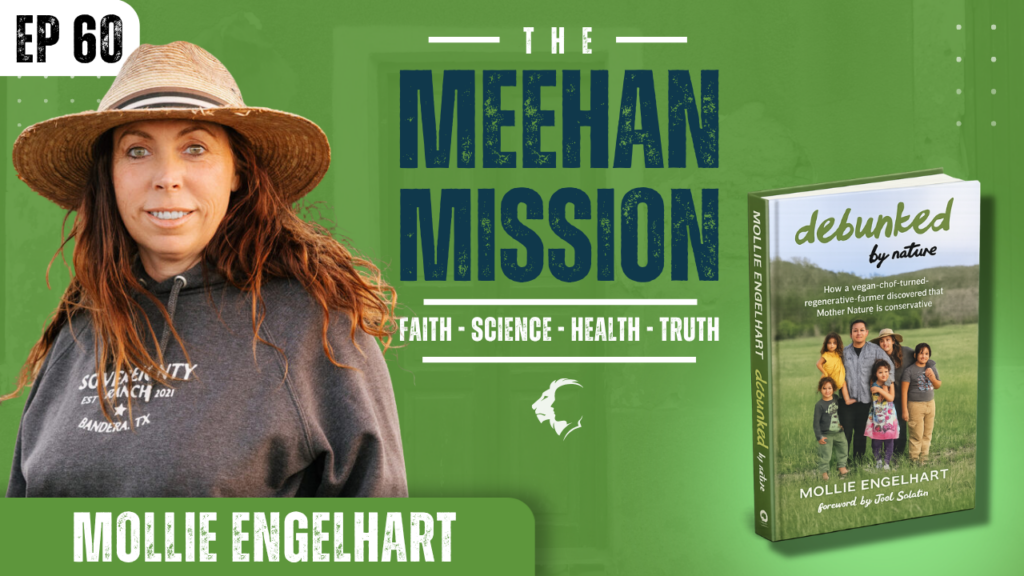
Cathy Meehan: Today’s conversation on the Meehan Mission podcast, we are gonna focus on the root of health, which is our food system. I’m joined by Mollie Engelhart. She is the founder of Sovereignty Ranch. This is a regenerative farm in Texas that really focuses on the connection of how our food is grown, how that food nourishes our body. and how good food really impacts our overall wellness. Mollie has been in the real food industry for years where her family had a very successful vegan chain of restaurants in California. but Mollie’s critical thinking skills actually led her to regenerative farming. So now in Texas where they support regenerative agriculture, they also focus on helping people understand where their food comes from. So we know the truth behind good health is good food. So I’m so excited to introduce you all to Mollie. Let’s welcome her to the show. Cathy Meehan: Well, hello everyone and welcome to the Meehan Mission podcast. My guest today is Mollie Engelhart and she is the founder of Sovereignty Ranch. I am so excited to have you here today, Mollie. Thank you for joining us. Mollie Engelhart: Thank you so much for having me. And we had different times trying to get this done, but today is the day that we’re getting it done. Cathy Meehan: Absolutely. So let’s start because you know really the root of our health really is I think it starts with our food and our nutrition and I know that you have had this incredible journey of restaurants to regenerative farming. So if you want to just maybe start you know California to Texas how did it happen? Mollie Engelhart: So I am most well known for being a vegan chef in Los Angeles. I had five very well known vegan restaurants in LA. I was super committed to environmentalism. I had been indoctrinated with the idea that vegan food was the way forward. I was raised in a no meat household. My mom is still vegetarian to this day. And so I was really passionate about the environment. And in 2013, my brother came home from New Zealand and he had listened to Graeme Sait at this conference. And he just was totally inspired about regenerative agriculture when he got home. And regenerative agriculture was not a thing. It wasn’t like, I mean, it was a thing, but it wasn’t something that people knew this term. It was like, there was organic and conventional, but nobody knew about regenerative. And it was an aha moment for my brother and he started Kiss the Ground and has subsequently made a bunch of films and a nonprofit, blah, blah, blah. But so I got really inspired through my brother about regenerative agriculture. And I wasn’t ready to give up the idea of veganism yet, but I was like inspired. And so I started trying to convince every customer that would come into the restaurant. Hey, you know what, you should have a farm and I’ll bring all the compost from the restaurant. It’s gonna be awesome. We’re gonna make humus. It’s like soil. It’s really important. Microbiology, human health. And I’m like trying to explain it to every customer. And it’d be like, Courtney Love or the Clippers coach or some, anyway, I thought they had the money to do it. I would try to convince. And they were just, you know, customers like, yeah, I’m trying to eat my food. Thank you for your ideas. So I realized like I had to do it myself. And so, through a whole journey, it took from 2013 to 2018 to really buy a farm, save up, find a place, all the stuff. And then through a habit, I’m going to have this vegan farm. I’m going to do vegan regenerative agriculture. I’m going to be the first one. I quickly realized that nature doesn’t have any veganism. It doesn’t even exist. Life and death are constantly cycling. And we can’t make dietary choices that move us away from God’s design. And God’s design just started becoming more and more present to me and through, where does our fertilizer? Organic fertilizer comes out of the consolidated feedlot system out of animals that are filled with antibiotics and feed that’s filled with glyphosate. And I’m wondering, what have I been committed to? It doesn’t make any sense. And so I start, but I’m terrified of the vegans because they are the original cancel culture. And so I’m secretly feeding, start feeding my kids raw cow’s milk and I don’t let anybody come to my farm. Cause I don’t want them to know that we have all these animals or that my husband eats animals or anything, right? And so the secret life of Mollie, the secret life of me. Cathy Meehan: Yes. Cathy Meehan: The secret life of Mollie Engelhart. Mollie Engelhart: And then COVID started happening and there was all these other lies similar to the lie about veganism being the best, best thing for the planet. Environmentalism that we are a plague, a pestilence. We are the problem on the planet. And I just started to see, I’d already woken up about veganism and environmentalism, but, and I had never been vaccinated. So there wasn’t a chance anywhere that I was going to take the COVID experimental gene therapy and I had known about this kind of gene therapy because my best friend died in 2018 of cancer and she was actually trying to get in a trial that used this same kind of gene therapy for attacking specific cancers. So I knew that this was not a vaccine, this technology that it was, and she died, she did not get in that study. But there wasn’t a chance in the world that I was gonna take that vaccine. Mollie Engelhart: And all these friends that I had that drove Teslas and had homeschooled their kids so they didn’t
Andrea Reed on Fascial Maneuvers and Holistic Healing Through Community
Cathy Meehan: Welcome to the Meehan Mission podcast. I’m your host, Cathy Meehan. And on today’s episode, I’m so excited to introduce you to something that I was not very familiar with. It is fascial maneuvers. I hope I said that right. So my special guest is Andrea Reed. She is the founder of the Oklahoma Center for Wellness and her special gift is being a connector of like-minded people who are seeking and practicing natural and holistic health. Andrea has just been the best resource for me because she is always and constantly gathering like-minded people together so that we can share our knowledge and help spread that to help everyone become the scientists of their own health. So in today’s episode, I hope you guys participate and do some of the fascial maneuvers that she had me do. It was fun, it was relaxing, and I think you’re gonna find benefits too. So right now, let’s get started and let’s welcome Andrea. Cathy Meehan: Hello everyone, and here is my special guest today. Hello, Andrea, how are you? Andrea Reed: I’m great, Cathy. How are you? Thanks for having me on today. Cathy Meehan: You are so welcome. So let’s start this off because I have questions for you. First of all, give us a little bit of your background on how you got into the whole holistic movement because I think it’s really, you know, that personal journey really helps people. Andrea Reed: Yeah, most people that are in this industry for work or on this journey for themselves, you know, have come through something, through a need. And, you know, I’m second generation, holistic, natural health and wellness. My mom had a decade long illness when I was growing up. So the formative years of my life, she was struggling, working full time, building her house, raising a child. And she was seeking ways to heal herself from a misdiagnosis. and didn’t know she was misdiagnosed with an incurable disease at the time. When she found a naturopath in Vancouver, because I’m from Canada originally, that could help her, her symptoms were reversed in three weeks. So I grew up knowing, right, and she doesn’t say she had a decade long illness. She says it took her nine and a half years to find the right answers. And so that has really been informative for me, right? Because it’s like if we shorten the length of time it takes for people to find answers. Cathy Meehan: Wow. Cathy Meehan: like that. Andrea Reed: the quality of their lives and their families and for themselves and their children and for generations to come drastically changes. So that’s how knowing that the body could heal itself. When I had my own health crisis, shortly after becoming a new mother, I got into the emotion side of things. So I learned the nutrition side really early, just through the experience in our family. And I learned how like, Cathy Meehan: Mm-hmm. I agree. Andrea Reed: repressed trauma and emotions, physical and emotional stuff stuck in the body, all came to the surface through my first birth experience. And so I had a choice. mean, I’m holding this new baby who’s not a baby anymore. He’s almost as tall as I am. And think he’s lot taller now. He grows every night. But I had this choice and I was like, I need to heal myself for him so I could be there for him. And so that got me searching for ways to somatically remove Cathy Meehan: Hahaha! Cathy Meehan: Mm-hmm. Andrea Reed: move through stress in the body just so that I could feel more free and light and less pain in my body. Cathy Meehan: Well, know, it’s very often it’s either our own health issue that makes us seek other types of remedies and therapies and healing, or it’s somebody very close to us who’s gone through some sort of a crisis in their medical condition. so often, like you said, your mom was going through probably like this Western medical system. that really wasn’t looking outside of the box. They’re not digging into kind of root cause things or natural holistic ways to heal, which is why I’m so thankful that there are more people really out there learning. And not only are you learning, but you’re sharing that information that you have learned so that you can help other people. And I just want to commend you, Andrea, because what you have done for the state of Oklahoma and our area is just phenomenal because you are really a connector and you help connect people together to ensure that our messages get out. So I just want to thank you for that. So thank you. Andrea Reed: Well, and thank you. Thank you so much. I had to pop up. Cathy Meehan: Yeah, it’s been great. So specifically why I wanted to bring you on for our community is what you are doing with the Human Garage and with fascial maneuvers, because that’s really a new concept for me. I’m not that familiar with it. And so I would love for you to kind of take us down that road on maybe a little bit of the history of it and how you are utilizing that now and helping people. Andrea Reed: Yeah, that would be great. Thank you. And truly, like, I appreciate you saying that, Cathy, and also the work that y’all do nationwide with people and really informing parents what options and choices and freedoms that they have. It’s huge. So I appreciate you very much. I love doing this. Yeah, so, Fascial Maneuvers is a radical self-care movement practice that was started by Human Garage in 2020. Cathy Meehan: Thank you. Cathy Meehan: You bet. Thank you. Andrea Reed: And the Human Garage had been doing clinical practice in like the one-on-one treatment room method for a very long
Del Bigtree on Informed Consent, Public Health, and Choosing Courage
Cathy Meehan: I love to interview movers and shakers and today’s guest is someone who’s been at the center of some of the most controversial conversations in public health and media. He is an Emmy Award-winning producer and investigative journalist. He has spent years challenging the mainstream narratives. He advocates for transparency, informed consent, and open debate in science and medicine. I’m joined by Del Bigtree. He’s the creator and host of The HighWire and the must-see documentaries, Vaxxed and An Inconvenient Study. I want to welcome you all to the Meehan Mission podcast where we explore the intersection of faith, science, truth and health and who better than Del Bigtree to join in our conversation. So let’s get started and let’s welcome Del to the show. Cathy Meehan: Well, everyone, today I have the man, the myth, the legend, Del Bigtree. Del, thank you so much for joining me today. It’s great to have you. Del Bigtree: It’s great to be here, Cathy. I’m looking forward to this. Cathy Meehan: Good, good, good. I know that we’ve both been flying all around the states, you all the time. And I just really take this opportunity to thank you for all that you have done and all that you will continue to do to help educate the people, just being the brave person that you are and spreading that braveness to everyone else. So let’s start with that, Del, because you are brave and you don’t step down. Del Bigtree: Okay. Cathy Meehan: So what is it that sparked that personality or that character trait that you have of never giving up, of always telling the truth? I mean, were you born that way or did your mama teach it to you? Del Bigtree: I mean, you know, that’s that’s probably the biggest question I grapple really honestly you know nature versus nurture. I do wonder what I am you know is just a natural being would I have had ethics or morals or things, if I hadn’t had parents, my mom especially, that were very very committed to raising children and. Cathy Meehan: you Del Bigtree: in a very specific way. My mom knew she was raising us different than anyone she’d ever met before. you know, was sort of, I think my mom and dad were on a really powerful, you know, spiritual trip coming out of the 60s. You know, they’re hippies, not like the drug hippies, but more like the political activists. And apparently there were different things, which is interesting. I don’t think a lot of people know that. They were getting deep into some spiritual work, a lot of dream interpretation, Bible reading, and they raised us to believe we could change, that not just we could change the world, that we were here to change the world. And so, you know, I’ve said it, you know, I gave a talk in San Diego at Tracy Slepcevic’s event, Autism Health Summit, and Cathy Meehan: good. Del Bigtree: you know up until Vaxxed there’s a lot of cool things that happened in my life and I did, I was in theater in New York, I was into performing I, you know, got the Broadway touring company and Hair, the musical sort of ironically to play a hippie like the parents had grown up with. But I always had and you know I won an Emmy Award on The Doctors, but I always had this this hole I couldn’t quite fill that I really. I just had this profound sense that I hadn’t found my calling and was even doing, you know, there was a men’s group in California where a great Native American guy was doing sweat lodges and we would all sweat together once a month and pray and chant. you know, I every my prayer was the same every time. Like, I want to find that thing I’m supposed to be doing. And I’m sure, I’m so completely sure it was Vaxxed. I mean, when I, you know, through all the miracles that I told, it was a lot of fun to tell that story. So many beautiful details, but the moment I sat and finally saw this documentary and sitting in Andy Wakefield’s basement, I had a really, just a unique thought, which is not only am I qualified to make the adjustments to this film that it needs, I actually thought given how I was raised, the work I’d done on The Doctors, how many people have made science into entertainment. There was probably about 15 total, the team working on Dr. Oz and the team working on The Doctors and I was on The Doctors. and then I would have understood this topic. So yeah, I felt like of all the people in the world, I’m the single most qualified person for this one very specific task, which was a… a life passing before your eyes moment that I still grapple with, is it seemed like every failure and every success, the ones I cried about, like I didn’t end up being Steven Spielberg, the filmmaker I thought I was going to be. And it just seemed like everything was designing me for this moment. I truly felt like God had been preparing me. Cathy Meehan: Thank Del Bigtree: And so the other biggest question is, people say, how’d you get where you are? Kids will come up, you know, I’m getting the film or theater or whatever, you know, how do you get success? And, you know, I honestly wonder, was there any other door to a successful life that I somehow walked past or missed? Or were all those missed opportunities, like they had to be missed? Cathy Meehan: Mm-hmm. Yeah. Del Bigtree: because there was one thing I was here to do. don’t know. That’s why I really contemplate that a lot. Cathy Meehan: Yeah, well, I feel you because, I mean, who ever thought I’d
Eric Barber on Choosing the Right Reps for Strength, Muscle, and Fat Loss
Cathy Meehan: Are you doing the wrong number of reps and actually sabotaging your health? Should you go heavy weight and low reps or should you go light weight and high reps? I mean, really, what is the answer? Well, on today’s episode of the Meehan Mission podcast, we’re going to talk with Eric Barber from Barberic Training. He’s going to help break down the strategy behind the reps. So really, how do they impact strength and muscle and endurance? So if you’re ready to find out the right approach for you, let’s welcome Eric to the show and let’s get started. Cathy Meehan: Well, hello everyone. Welcome to another edition of the Meehan Mission podcast. And it is our favorite online trainer, Eric Barber with Barberic Training. Eric, so great to see you today. How you been doing? Eric Barber: Mm-hmm. I’m good, I’m good. How are you, Cathy? Cathy Meehan: I’m doing great. Actually, I do have to admit my hamstrings are a little bit sore, but I wanted to get you on today because there is a lot of confusion and discussion on reps. And I know me personally, I have the question. I mean, am I supposed to do heavy weights and low reps? Am I supposed to do, you know, light weights and high reps? Eric Barber: Yeah. Cathy Meehan: Am I trying to bulk up? Am I trying to lose weight? There are so many questions and I know you are the guy to answer them all. So let’s just start off with that. What does a person need to know about reps? Especially if you know I’m working out and I want to see certain results. Where do I start? What’s the strategy? Eric Barber: Yeah. I love this topic. I know I say that every time, but I do. I geek out on this stuff. What we’re talking about is not just reps. We’re talking about sets and reps, okay? Different training modalities. To break it down, you know, there’s a lot of noise out there now. A lot of know-it-alls, a lot of people saying, you gotta do this, you gotta do that. I’ve been doing this for 30, 40 years now. Cathy Meehan: Okay. Okay. Mm-hmm. Eric Barber: What I like to do is always go back to the basics. There are people that paved the way for us a long, long time ago and did all of this work. And we learned from them and we’ve been adding to it, adding to it, and then we just get more scientific about it. But then sometimes it just gets to a point where it’s just so much. Cathy Meehan: Okay. Eric Barber: data and so much science and everybody’s a know-it-all and it’s getting hard to know the difference between what’s real and what’s not anymore. So I like to take people back to the basics, okay? And so the basics are if you keep your repetitions between one to five reps, you are training for extreme strength or you are training for power. So when you look at people like Cathy Meehan: I agree. Thanks. Eric Barber: Olympic weightlifters, what you see in the Olympics, versus power lifters, right? Huge difference between the actual look of each of those kinds of athletes as well as what they’re trying to do. Okay, but they’re still using the same rep range. So, in that, like just starting there alone, like how in the world do you even break into this? So a power lifter… Cathy Meehan: Thank you. Eric Barber: Is basically, they’re training on three events, right? The deadlift, the back squat and the bench press and those are known as the slow lifts. Okay, so power lifters are going for extreme strength in that one rep range a one rep max, right? That’s what they train for in three events and to me, it’s awesome, but I can’t train like that all the time for year after year after year. That would drive me crazy Cathy Meehan: Okay. Eric Barber: Right? I’m more of a multi athlete adventure style. You know, everything I train for is to be able to do cool things out there. Right? So, the power lifters, they really, they really are trying to prove how strong they are on those three lifts, but they call it the slow lifts because the barbell moves very, very slow. Okay. Now an Olympic weight lifter, what you see in the, in the Olympics way more Cathy Meehan: Yeah. Eric Barber: Complex. It doesn’t mean that it’s harder it’s just more complex of a movement because now you’re adding speed Okay, but their three movements are the snatch and the clean and the jerk the snatch is one movement where you take a barbell from the ground to overhead in one fast explosive movement right, and the clean and jerk is where you break it up into two movements you clean it up to your chest You take a deep breath and then you punch it overhead for a jerk. Okay, so the back squat, deadlift, and the bench press are the three slow lifts of powerlifting and the snatch, the clean, and the jerk are the Olympic lifts, the power of the explosive Olympic weightlifting. So those guys train for one rep as well, but two totally different athletes. When you look at a bodybuilder, I mean, I’m sorry, a powerlifter, They, they’re usually big and husky and they’re going for that maximum weight. When you look at an Olympic weightlifter, they’re all lean and muscular and ripped. And it’s like, what? Well, when you add that speed in there, you have to train a totally different way. So when they train, they usually train in the one to five rep ranges. Okay. So that’s, that’s the first, that’s the, that’s where we start. Right? Those guys are extreme athletes in strength and extreme power. Cathy Meehan:
Macy Hamilton, NTP on Simple Nutrition Habits for Healthier Families
Cathy Meehan: Let’s be honest, many of us know that we need to start eating healthier. But with all the information out there, we just don’t know where to start. On today’s episode of the Meehan Mission podcast, our special guest is Macy Hamilton. She’s a nutritional therapy practitioner, and her job is to help individuals and families and guide them through the world of nutrition. Now there’s a lot of information out there and she’s gonna help us break it down into what’s important, how we can take little steps in transforming the way we prepare meals, and what do we do with those picky eaters? Well, Macy’s got some great ideas and great information. So let’s welcome Macy to the show. Cathy Meehan: Well, hello everyone and welcome to today’s episode of the Meehan Mission podcast. And I have a special guest, Miss Macy Hamilton. Macy, thank you for joining us today. Macy Hamilton: So happy to be here. Cathy Meehan: Well, first of all, we know how important nutrition is for health of ourselves, health of our family. And because you are a nutritional therapy practitioner, I thought who better to come introduce to our community so that you can help give us tips, hints, you know, what do we need to do to help raise healthy families and healthy kids? Macy Hamilton: Yeah, perfect. Well, I’m so happy to be here, first of all. I just want to really simplify it for everyone because I know that parents, I’m a parent myself, I have two little boys, they’re three and four, and I know that it can be just so overwhelming. We don’t know where to start. We’re not trying to feed our kids poorly. We want what’s best for them. Like I said, it’s just so overwhelming. We’re being told from so many sides, something’s bad, good, vice versa. It’s so hard. So I’m here to really just simplify it and give parents the tools that can help them nourish their families, take it into their own hands and create healthier lifestyles for themselves and for their kids. Cathy Meehan: That’s a great place because the other thing I want to bring about is, you know, what got you into wanting to learn about nutrition? And did it have anything to do with how you were raised? Macy Hamilton: That’s a great question. So it did have a lot to do with how I was raised. I grew up with four other siblings. I’m one of five. My dad was a medical doctor and he, you know, we grew up in a very conventional household. It was really the standard American diet. It was, you know, Kraft Mac and Cheese with like cut up very overly processed sausage, stuff like that. Fruity Pebbles were like a staple in our breakfast, hot pockets. Just think standard American diet. That’s how I was raised. My dad was addicted to Mountain Dew for like years of his life until finally he made the change one day that he was an eye surgeon. And then he saw that, okay, instead of treating the latest stages of disease, let’s get to preventative medicine. And so… his journey really took our whole family through this journey of, you know, a more holistic way of living. And if that story sounds familiar to you, I, my dad is Dr. Jim Meehan and this is my mom. So, it was really, you know, just an amazing journey, witnessing it from a child to now where I am today. have that experience, can relate to so many people. It’s like, yeah, I grew up on the standard American diet and I’m fine for the most part. For the most part. You know, it’s kind of like no better, do better. And so I’m just so thankful to be here and the legacy that my dad built and the mission that my mom continues and me as well. And so I’m happy to be here. Cathy Meehan: That is great. Well, you know, that really makes, well, number one, you forgot Toaster Strudels. my, Toaster Strudels. was a staple in. my children’s diet. Sorry about that, everybody. Know better, do better, right? But really, I just want to point out that trickle effect of dad realizing, or Jim, Dr. Meehan, realizing that we need to start focusing on nutrition and getting out the bad and bringing in the good, substituting where we can. And we really just kind of took gradual steps in doing that. But look what that decision carried out into the rest of the family. And now you make a career out of it and you’re making sure that your children are, you know, eating healthier and your husband’s eating healthier. And so what’s so important and again, why I wanted you to bring on to the show is that you can help educate parents on ways to incorporate healthier nutrition. So where do we start? That’s the big question. Macy Hamilton: That’s the thing. And it starts with us as parents realizing that what more is caught than what is taught. And that’s really how I saw my parents transition. And at first I was like, uh, what is this? Like, no, I want to keep buying this stuff. But it’s also like they, they stopped buying these things like the Toaster Strudels, the Fruity Pebbles, the Kraft Mac and Cheese. And so we didn’t have access to that. And so it’s really taking it into your own hands as a parent, starting with yourself. And that, like my mom said, trickles down to your kids. And so it’s really about being intentional with how you are nourishing your family, starting with small steps like that. Cathy Meehan: That’s good. So is there any sort of like a beginning step? What’s the main framework that a mom or dad or somebody wants to start with if they’re going to create
Mary Holland on Informed Consent, Children’s Health, and the Legal Fight Over Vaccine Policy
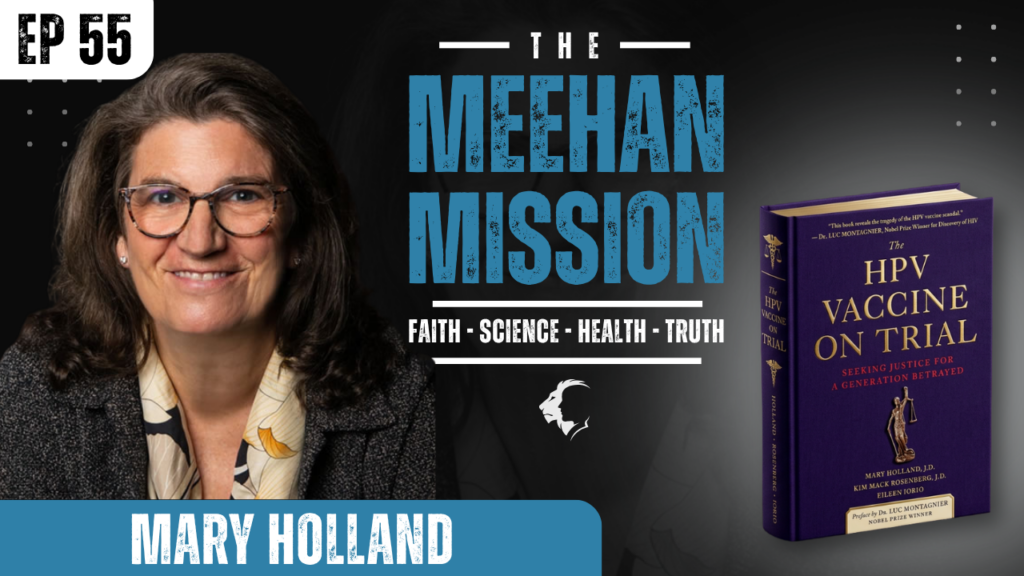
Cathy Meehan: Empowering people to take ownership of their wellness is our mission. We want to explore the intersection of faith, science, truth, and health right here on the Meehan Mission podcast. My special guest today is Mary Holland. She is the President and General Counsel of Children’s Health Defense. Mary has decades of experience in constitutional and international law. Cathy Meehan: It was her own son’s vaccine injury that gave this brilliant mama bear the attitude needed to legally challenge the medical industry. She has spoken before Congress, state legislators, and audiences all over the world about informed consent and medical policy. She is also the co-author and editor of several phenomenal resource books. Cathy Meehan: The HPV Vaccine on Trial, Vaccine Epidemic, and Turtles All the Way Down. I am honored to welcome Mary to the show. Cathy Meehan: Hello everyone and welcome to the Meehan Mission podcast. And today my special guest is Mary Holland. And Mary, I am so thankful that you took the time to allow me to introduce you to my community if they didn’t already know who you were. And I also just wanted to let you know that you were one of Jim’s heroes. He… Cathy Meehan: constantly talked about you and how brave you were and that how you would stand up for our children and just give everything. And I can’t tell you how many times we were sending people the HPV Vaccine on Trial, and we’ll get into your books in a little bit, but I just appreciate you so much. And so thank you for taking the time. Mary Holland: Well, thank you. you know, we miss Jim very much. Cathy Meehan: Yeah, he’s a hard person to replace. He will never be replaced, that’s for sure. But we are going to make sure that his voice is heard and that we carry on that mission, which is why we created the Meehan Mission podcast so that we can continue to bring on guests like you who are experts in their field. Because really, when it comes to awareness and education, Mary Holland: Not replace. No. Cathy Meehan: The more that we know and the more that we can push out to our community, that’s how we win this battle. And you’ve been in this fight for a really long time. I’m so excited to see all of this, the legal part, which is really kind of, with you and with Aaron Siri, just kind of leading the pack, that that’s really making the difference. That’s making the difference. But so I have a question for you. Mary Holland: Yeah. Mary Holland: Yep. Yep. Yep. Cathy Meehan: So what in your lifetime or was it in your childhood? Was it in middle school, college? What made Mary realize that she was built differently than everybody else and she had this fight in her? Mary Holland: Well, I suppose I’ve always been willing to stand up for things that I believe in. like most people, if I can go along with the crowd, I will, Cathy. If things seem to be OK to me, I’m not going to really step out of line. Cathy Meehan: Mm-hmm. Mary Holland: One of, you know, I’ve always been willing where I really disagreed with people to step out and say, no, I really disagree. you know, on this issue, there’s just, when I do really strongly disagree, I feel it so deeply that even though I have lost people very close to me, I’ve lost jobs, all that kind of stuff, it doesn’t really matter. You know, I just. Mary Holland: If I have a deep conviction that I’m doing what the universe is telling me to do, I just have to accept that there’s things that go along with that. I can be really sad about losing friendships and there are many I’m really sad about, but it doesn’t make me change my mind. Cathy Meehan: That’s good. Well, you know, it’s that determination. Do you like wake up every morning and with a mission and you go out the door and do it? Is that your personality type? I would, you know, you get so much done. What? Mary Holland: Not compared to how much there is to do, You know, I do the little bit I can. It’s like, know, Bobby Kennedy would say, you know, I just can do it with my own little piece, my own, I’m only in charge of my own little piece of real estate. I like getting things done, Cathy. I like getting things done. I am pretty mission driven. So, you know, I am at CHD and Children’s Health Defense and we are Cathy Meehan: I know it’s like a never-ending list. Mary Holland: doing a lot, as you point out. And so I do feel very mission driven to support the team and help get things done and be aware of what’s going on and support what our mission is, which is to end the epidemic of chronic childhood disease in the United States, but globally and to educate people, to put in place, to find sort of… Mary Holland: redress for those who’ve been injured and to put in place safeguards so it doesn’t happen again. you know, I do feel I have been in this for about 25 years, Cathy. And in that time, I do feel like there’s been tremendous progress as much as we’re not there yet. And we’re not. We are now really getting into the courts in a way that was pretty unimaginable 20 years ago. The fight is on. You know, I sometimes quote for people, it’s attributed to Gandhi at Mary Holland: probably wasn’t Gandhi, but they say, first they ignore you, then they ridicule you, then they fight you, and then you win. And so we are very much in the fight stage now. They can’t ignore us anymore. They don’t