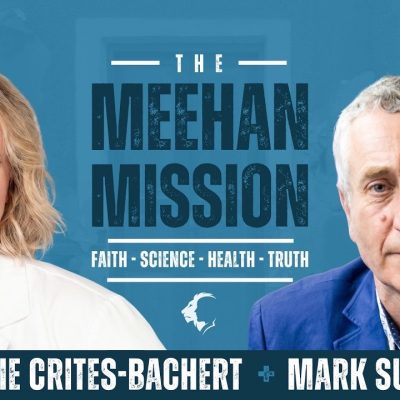
Cathy Meehan: The world of transgenderism is dark and secretive, and today people are introducing confusion and doubt into the identity of our children. We have to understand that even since the time of the garden, Satan came to introduce doubt and confusion to Eve. So the playbook has never changed. But we’ve got to do something to stop it. And how do we stop this doubt and confusion? Well, number one, we create awareness. And that’s exactly what my guests have done. We are joined by Dr. Melanie Bockard Kitz and Mark Sutherland. And together, their team at imageunshaken.com has created the resources for children’s education and to help parents on this journey. But not only that, they are working on a documentary to really create the awareness of the darkness and the secretiveness behind transgenderism. What we need to do is take that awareness so that we can have prevention and also resolution and solutions. So, please let’s welcome Melanie and Mark to the Meehan Mission podcast.
Cathy Meehan: Hello everyone and welcome to this very special edition of the Meehan Mission Podcast. Today I am joined by two very special guests. I have Dr. Melanie Bockard Kitz and also Mark Sutherland. And I’m just going to tell everybody in our community that this is an impromptu surprise podcast because Melanie happens to be in town with Mark and they are doing some incredible work. Specifically, they are working on a documentary, and who better to talk about this. I’m going to let Melanie start with how in the world did we get to where we are and what are y’all up to?
Dr. Melanie Bockard Kitz: Well, thanks so much. So actually what we’re up to is—I’m a urologist and pelvic reconstructive surgeon, as you know, and we decided to embark on the filming of a documentary because I had an idea and I pitched it to Mark, who is known in his own right for his film production, and he thought that it was a great idea. So we found a director who also has great things to his credit, and we all joined forces and we prayed about it and we turned it over to God and said, “This is your story to tell.” And so what we’re doing is exploring transgender ideology from the origins of spirituality throughout time and its progression to get us to the point that we are at now and where we are going to go if we do not right this ship. And of course, because I’m a urologist and a pelvic reconstructive surgeon, I have a unique take on all of this because I can reconstruct the entire pelvis. From a medical standpoint, very few of us have that expertise to be able to speak to such things. So I can add the medical advisory portion of all of it where Mark and our director, Andrew Mullenax, have their creative side that they can make it come to life. And so we joined forces. We started a production company called Remnant Films. And Remnant Films will be handling the documentary and all of the other spin-offs that will be forthcoming as a result of the amazing people that we’ve been able to interview for this particular documentary.
Cathy Meehan: Well, I have to tell you that the way God works and puts people together and circles around—for you to come back around this way and then now to bring Mark and just how we can all come together as a community. Because the one thing that I want to point out is this is a very, very controversial topic that you guys have—I would say chosen, but I also believe that it was God. And I just pray for protection over you and your whole crew while you are doing this. And I ask that our community pray for protection over you all, too. Are you scared, or does that motivate you?
Dr. Melanie Bockard Kitz: No, I am not scared because I know who I am in Christ. I want to put that out there. I am not afraid of powers and principalities because He that is in me is greater than he who is in the world and trying to sidetrack all of this. So no, I’m not afraid. Nobody on our team is afraid. We are an all-Christian, devout Christian team. We are not just Christian in name; we walk the walk. And we have had to clean a room when we’ve walked in. We’ve had to pray demons away in real time. We’ve had targets and threats, but the safest place that you can be is right in the middle of where God puts you. If He puts you there, He will protect you. And I’ve said it before—and my mother hates to hear me say this, but it is the truth of the matter—what is the biggest punishment that I can get? They end my life. My life is ended, oh gee, there’s a punishment, because at least I get to hug my daddy and I get to see Jesus.
Cathy Meehan: Yeah, absolutely. Well, I appreciate that. And I kind of find that people in our community, we’re already disruptors and we already know that we’re against the evil forces of this world, and that sometimes I feel like that just motivates us a little bit more. Well, Mark, let’s bring you into the conversation. Tell me, how did you guys meet and what is your role with the documentary?
Mark Sutherland: Kathy, lovely to be here and thank you so much for inviting us to be on this podcast. As you can tell from my accent, I am not from around these parts.
Cathy Meehan: No, he’s from East Texas! [laughter]
Mark Sutherland: East Texas, okay! I’ll try to double down. So, I’m from the UK. And you just asked an important question: Do I have fear? No. It’s not the first time I’ve engaged in maybe what’s called controversy on one level. I don’t mean that in a big-headed way, not at all, because like many, there has been a cost. So, how did we meet? We met through a mutual contact at a meeting. Then Mark very kindly asked, “Could you come out? Could we begin to make this happen?” Yes. We have done—I have a number of friends over here and a number of contacts over here. So far we’ve interviewed about 24 people. We’ve got a few more interviews to do on this side of the pond, and then we’re going to be interviewing people in the UK. We have also interviewed someone from Canada, and there may be more people to interview from Canada. We’ve put someone on camera from New Zealand. The reason I’m saying that is to show how this is expanding. You’ve alluded to this—this is a worldwide issue. And to back up what Melanie has said and what you’ve said, this is the biggest spiritual battle of our lifetime. I don’t take that for granted. There’s a very interesting discussion to have about where we are at on the eschatological time clock in regards to if people want to discuss the end of days. And in one sense, this subject when you go back in history is nothing new. We look at what the Bible talks about regarding eunuchs, and why all of this history is unfolding. So that’s how I got involved, and I’m privileged to land here and start making things happen. We had a big film shoot up in Indiana, for argument’s sake, and then we’ve been down in Dallas interviewing all sorts of people, but they all connect.
Mark Sutherland: The other thing is that I’ve run out of conspiracy theories now. People need to bring new ones to us because we’ve proven the fact that they are all real. And I don’t say that lightly. There are things that we are dealing with when people use the term mind control—MK Ultra—yes, it is real. But it’s about breaking it down to speak to people that have the receipts and to explain the history of this, not to just give a conspiratorial sort of overview for clickbait. The way that we see this, Melanie is in a supremely unique position because of what she does for a living. No one can take that away from her whatsoever because she can speak with passion, professionalism, and knowledge gained over many, many years. I’m not just saying that because I’m sitting next door to her; it’s true. By speaking from that position, she becomes a threat because you can’t argue with her. And excuse me if it sounds a bit base, but when we are talking about the fact that body parts from young people are being removed, we have to talk in these terms. This is the reality of it, and the reality is that people are not informed whatsoever of what is actually going on.
Mark Sutherland: I’ll end with saying this statement, and I’ll ask people to look up the history. There is no difference in my own mind—this is personal opinion—between what Mengele was doing in Auschwitz and other concentration camps to young Jewish children (particularly with a propensity for twins) with all his disgusting experiments, than what we are now seeing in operating rooms where they turn around and say it’s perfectly acceptable to do double mastectomies and cut off male body parts. When we say it like this, suddenly people will start to wake up and go, “Hold on a minute, what are you saying here?” I’m not saying that to be offensive; I’m saying that to get people to sit up and draw attention to what’s going on. The only way you can do that is just explaining it how it is, and Melanie can do that more than myself regarding describing the surgeries that go on.
Cathy Meehan: Yeah. So in particular, Melanie, because of your experience interviewing people that have gone through transgender surgeries and everything, is there any particular instance that you recall or that you really want the general public to understand? Just really to wake people up. I mean, how did we let this happen?
Dr. Melanie Bockard Kitz: So the documentary is specifically dealing with transgender ideology as it pertains to children, but also to individuals of all walks of life, and we chronicle its spiritual origins. In answer to your question, “How did we get here?” the short answer is: Well, how far back do you want to go? Because we are exploring this literally from the spirituality aspect of the garden and chronologically moving throughout time with how things have been put into play throughout the ages to get us to this point—everything from secret societies to mind control to Nazi agendas, and how that web all interweaves. What people can look for and try to be aware of is that nobody is immune to this ideology. It is literally analogous to cancer. We all know somebody or have personally experienced cancer; transgender ideology is the same thing at this point in time. If you have not personally experienced it, then somebody in your family has, or somebody in your friend circle, or you know somebody caught up in it.
Dr. Melanie Bockard Kitz: It is truly a spiritual battle. It was put into motion in the garden, and Satan does not change his tactics. The original tactics were to plant the seed in the mind of Eve to question God’s perfect design. And that is exactly what the same spiritual agenda is at this point in time: to question God’s perfect design. That’s what we need to be aware of. That’s why we need to build good spiritual foundations for our children and have those good spiritual foundations ourselves so that we have discernment and can recognize those spirits.
Dr. Melanie Bockard Kitz: To your question about whether I have a specific instance in mind—yes, I do. Particularly one of the interviews that we conducted with a detransitioner, where we saw the manifestations of mind control and triggering in real time. We saw the manifestations of demons in real time, and it was something that we all recognized because we are all devout Christians who have battled that spiritual nature throughout our lives. We could recognize the grave spiritual battle and the manifestations in real time, and we were able to pray right in that moment. The only thing that spiritual warfare responds to is the name and the blood of Jesus. So yes, we experienced that during filming on more than one occasion. As Mark says, he’s running out of conspiracies. I call myself a theorist looking for a conspiracy to believe in, but this is stuff that most people will poo-poo and say, “Oh no, this is just conspiracy theory.” No, we witnessed it in real time, and it’s almost surreal as you are experiencing it.
Cathy Meehan: Well, I think that’s going to be great with the documentary—that people can actually see it and experience what you have experienced. I also want to go back to talking about how Satan really invites confusion. I think a lot of these children or people that want to transition are confused. It is a mental confusion, but I also want to add that it’s an environmental confusion because you think about all of the endocrine disruptors, the plastics, the soy, the toxins, and the things that we inject into our children that are screwing up their immune systems.
Dr. Melanie Bockard Kitz: DuPont survivor here! I grew up five miles from DuPont in West Virginia. What is in our water?
Cathy Meehan: Yeah, the birth control in our waters! It’s just, you know, we’re being attacked—and I think that’s Satan’s plan, to attack us mentally and physically. Do you see what types of resources are out there for these children? I mean, I would think that would be lacking.
Dr. Melanie Bockard Kitz: It is severely lacking. Going back to what you and I were speaking about earlier, everybody’s doing this victory dance over the detransition clinic being opened up by Texas Children’s Hospital, and then Cleveland Clinic has jumped on the bandwagon. Everybody’s doing a victory lap over that—meaning the people that have fought for these things. The problem, and the elephant in the room that nobody wants to address, is you can’t just set up one of these clinics with execution 90 days from the settlement. You can’t do that. As a clinician already involved in an organization that helps to find care for detransitioners, I know we can’t find that care. The resources are severely lacking. So unless it is a well-thought-out, well-planned-out concept, you’re not going to be able to execute it in 90 days and expect there to be good care.
Dr. Melanie Bockard Kitz: The clinicians who led these children, adolescents, and adults down this road to begin with don’t know how to take care of them because it was experimental medicine with no protocol for treatment to begin with. There’s certainly no protocol to try to backtrack. You can’t expect the same clinicians who led these individuals down this path to then take them back up the path because there simply is no protocol. And these are the same clinicians that are leaving the patients high and dry when they say, “I want to retransition back to my former self.” So the elephant in the room is finding care for these individuals because it is just supremely difficult.
Cathy Meehan: Oh well, it just, you know—I love to talk about the corruption in the western medical community. They were making dollars and insurance reimbursements while they were transitioning these children, and then all of a sudden somebody says, “Oh well, you can’t do that anymore.” So, light bulb! “Okay, well let’s make money detransitionalizing them.” So, yeah, I mean, attaboy for changing your mind and trying to do the right thing, but you are so correct. Do you have the resources? Do you have the knowledge? Are you just experimenting again? I personally think you’re probably just doing it for the dollars.
Mark Sutherland: The other thing is with one of the people that we had the privilege to interview, who basically went through the surgery when he was 50. When he was a young pre-teen, he faced this whole aspect of gender dysphoria. Then at the age of 61, he gets radically saved by Jesus. Now he’s 67 years of age. So he had the surgery, he was dressing as a woman, and in the conversation when I interviewed him, he was turning around saying, “I have other friends that wish to detransition, but they do not have the finances to do that right now.” If you think about it, he’s 67 now, and this started when he was 9, 10, 11, or 12, and then he has his surgery when he’s 50 years of age. This has been a very long game.
Mark Sutherland: Unless you enter this arena, which is new for me, you just try to get your head around it. It has personally come home to my wife’s side, and it’s shocking. You learn about someone being given transitioning drugs as a young man and then going for full surgery. But then with the person that we interviewed, again, there is no money when they want to detransition. You are right—it comes down to the medical field, the insurance, and the money. “Follow the money,” as someone greater than us says. If you’re going to have transitioning surgery, you now need to build in the finance to detransition for that individual. Melanie can speak more into this, but what if after 10 years they start to regret the decision that they have made? How do you then come back to who you are? Your gender hasn’t changed. How do you come back to who you are? Just to reassure you, it’s defined at conception.
Cathy Meehan: Yes, defined at birth. Conception, that’s it. Birth, you’re just checking; you see it with your own eyes.
Mark Sutherland: That’s it, it’s there. But it’s all this conversation of it being fluid, that you can choose and all the rest. Uh, no. When people say to “follow the science,” Melanie goes, “Yes, I am following the science, and the science says this.” So just quickly to say that from an insurance point of view, you’re building in one thing, and now you have got to build in finance for detransitioning. Why are you even going there in the first place? When we were growing up in the 70s and 80s, a lot of young girls ended up as tomboys because culturally, if they’re on a farm in America, they’re going to be encouraged to be involved in certain activities. That’s a cultural thing. Whereas now, if people turn around and say, “Whoa, you’re a tomboy, you’re dressing in man’s clothes, that means you’re not a girl”—uh, what? I’ve never heard so much rubbish.
Cathy Meehan: It is. It is rubbish.
Mark Sutherland: Yeah, so I’ll say that. I won’t name the company, but when a company who’s extremely well known in the computer world turns around and within their healthcare, there is transitioning and there is money for transitioning applied to that insurance scheme—this is shocking to me because I sit back and look at this particular company and their history, which goes way back to the Second World War and before that, and you think, well, what else were you doing? So, yeah, it’s not so surprising.
Cathy Meehan: No, when you follow that. And I want to touch back on young girls growing up because Jim and I had five kids. Our oldest daughter, Ally, was a tomboy extraordinaire. I remember her in third and fourth grade dressing like a boy, playing all the sports, absolutely everything. And we just let her be a tomboy. Now she’s this blonde bombshell, gorgeous girly-girl, did pageants and everything. But we didn’t say, “Oh my gosh, she wants to be a boy, we better put her on some hormones.” I mean, where did that come from? Seriously, I mean, did your documentary follow the whole thing? Somewhere—Ally’s going to be 34—so in the last 20-some years, I just feel like it’s really attacked our children. Is it the school systems? I want to think it’s the schools.
Dr. Melanie Bockard Kitz: So, we do explore that, and we have an expert member on our team named Marcia Mezer who has a website called parentsonthelevel.com. She has been in the school systems for a number of years teaching sex ed and abstinence. Her husband is a pastor, and that is exactly what she explores—how she equips parents and where this came from because she has all of the receipts. She is able to show the indoctrination where this ideology has infiltrated our school systems, and how school curricula has changed over the years unequivocally. She has the data, the schoolbooks, and the textbooks from before and after, and they are the same books but with grossly different information. There are things that are added now that were never added before. And I’ll do you one even better than that: I was going through some of my urology textbooks—and there’s a textbook that I have that I stay current on because a new edition comes out every 3 years or so—my older editions do not have anything about transgender medicine or gender-affirming care. The newer textbooks have two to three chapters in them about gender-affirming care. Now, this is from the standpoint of a surgeon and my surgical textbooks. It’s not just sticking with children; it is infiltrating the medical system.
Cathy Meehan: Infiltration, let’s talk about that. What about social media? Social media is another one, I would think, now with how fast and quick the algorithms are, you get these like-minded people together and everybody’s turning—boys are turning into girls and girls are turning into boys, and it’s like a club. Talk to me about social media.
Dr. Melanie Bockard Kitz: So, social media has been a horrendous influence for the worst on this particular subject. And when COVID hit, it intensified because children, as we know, were isolated. They were doing everything online. School was done by Zoom; classes were done by Zoom. Children were isolated, and the only place that they had to go was on social media to these blogs and chat rooms. What they’re finding, because they’re already at a critical time in life where they’re starting through puberty, things are already confusing—because who wasn’t confused as an adolescent? Again, God has a perfect design. We all had to go through it, and we turned out just fine. For the most part, children do turn out just fine.
Dr. Melanie Bockard Kitz: But we saw a time during COVID where social media was really critical for kids. What they were doing during that time was going to these blogs and chat rooms and finding these predators and individuals. The one that comes to mind—his name is Jeffrey, and if you go to his website and his blog, he’s all done up in makeup and he is telling the children, “Your parents don’t love you. I love you and I think you’re beautiful.” It’s kind of like the old Romper Room speaking into the mirror: “And I see Kate, and I see Johnny, and oh, so pretty.” Children are listening to this, and that is nothing but predatory behavior on already vulnerable individuals. They started becoming influenced by this, and it’s widely available that you can find the charts showing that when social media hit its peak, we saw a gradual uptick in individuals identifying as something other than male or female. When social media hit its peak, that graph had almost a vertical spike of individuals identifying as something other than male or female.
Dr. Melanie Bockard Kitz: And then we saw it kind of waning a bit in 2023, but this became a horrendous epidemic. I saw it in the medical field during COVID—all of a sudden, this explosion in the medical community. You have to understand I was also in Portland, Oregon at the time. So, no shout-out to Portland, Oregon, because it is a hotbed of ideology and demonic influences. But I saw an explosion in the medical communities and the medical field during that time. In fact, to that end, if you go and look at the statistics of highest-billing institutions and highest-billing providers regarding transgender care, Portland, Oregon—a hospital system that I used to work for as an independent provider—one of the providers is in the top five and the institution itself is in the top five of billing institutions for this. So social media has just been a profound influence on these children.
Mark Sutherland: If I can just talk into that as well. You’re talking about COVID, but we see the buildup before that as part of our research. Melanie and I have been in a very well-known bookstore that we won’t name, and I’d just encourage people to go into your local bookstore and start seeing what books are being read. Go into your public library—we’ve been there, too. Ask the school library. You’ve seen this; you’ve seen people go to school boards. You saw one very famous online video where a woman dressed up as a cat and went to say, “Look, I’m dressed up like this. Why is this acceptable when you’ve got children identifying as furries? You’ve got children identifying as cats, and there’s a cat litter box at the back of the class.” Before now, we would have called that a mental health problem and taken the children out to help deal with this. Where are the parents in this situation? It seems as though I’m coming down on them, but they need to get some strength here and deal with that.
Mark Sutherland: So all of that accelerated from COVID, but it’s coming back to where this comes from. A friend of Melanie’s who’s a nurse talked about the hospital that she worked at—which shall remain nameless—and said that there are four operations a week in regard to transgender operations. If I get my math right, if you then take the 50 states, and if you then take just one hospital in each state, you’re looking at multiplying that to 10,400-odd operations a year. Now, I think that’s at the lower scale compared to reality. So if you multiply that, this is rather frightening. Then in regard to everything that we’re doing, there is no doubt about it—someone can help us chase that money to work it out. As Melanie has said many times, it shocked me when I heard this: each individual child in America is potentially worth up to $4 million over a lifetime to the system. So if you then take $4 million times 10,400, look at how much money is going on.
Cathy Meehan: Yeah, yeah. Because they have to continue the surgeries and they’ll always be in the system; there is no getting out of the system. So I want to point out two things. First of all, audience and community, Mark, you are so polite that you do not name names. I just have to commend you for that because I’d be like, “That hospital!” and I would name it, and “That doctor!” and I would name it.
Mark Sutherland: There was a reason, there was a reason. They’ll come after us. But it is—and don’t get me wrong, I wish to… Oh my goodness, that’s not me. Oh, it is. I do apologize! [laughter] That’s okay, we’re real. That was an alarm.
Mark Sutherland: If you then take a company like IBM—so IBM during the Second World War, it’s all documented, right? IBM had a company called Dehomag (Deutsche Hollerith Maschinen), and they had the punch card technology. Edwin Black wrote a fantastic book called IBM and the Holocaust; get the book, it goes through this historical record. So what I’m saying is that they drew up rosters and knew where people were using punch cards, but then denied that they were dealing with the Nazi Third Reich. Just go to other companies. In 1925, this is historical, check it out: IG Farben is created to be a conglomerate to protect the German pharmaceutical and chemical industry. Carl Duisberg, who was the head of Bayer, was the first CEO of IG Farben. They then created Cyclone B that gassed the Jews in that situation. So I’m naming that company, and IG Farben became Bayer. It’s this whole historical record. Then IG Farben as a company was eventually dissolved.
Mark Sutherland: When I have been in a building in the UK that was a Bayer building, I was told that the bosses from Bayer would come over to the UK and say, “Don’t mention the war, don’t mention what we’ve done.” Right, this is all documented; there are books about this. If you look at Prescott Bush and you look at why they were selling oil to Hitler during the Second World War, there are many people, including Henry Ford, to look at from a historical point of view. What happens is that people don’t look at this because it’s uncomfortable. Going back to IG Farben as a chemical company, look at what they were creating. Even if you go back to the First World War and look at the gassing of soldiers, including my great-uncle, there was a German on the battlefield guiding where all this gas should go. So you’ve got to go back to history and look at all of this. Before someone goes, “Yeah, but what’s that linked with transgenderism?” look at how we’re treating human beings. Look at how a pharmaceutical experiment is being run. Melanie, you said it—it’s experimental.
Dr. Melanie Bockard Kitz: Not even that, but what Mark was just explaining about IG Farben and the punch cards keeping track of the rosters—now, fast forward. What does that have to do with the transgender industry and the indoctrination of children in the school curricula? Your children are being tracked. Did you know that? Did you know that the laptops and the iPads that your children are using in school and during COVID require them to check in and rate what kind of day they’re having and what kind of mood they’re in? All of that is being tracked. Audience, community, are you aware of that? Do you know that your children are being profiled? Same technology, just evolved over time from back in Nazi Germany. Your children are being profiled and the curricula is being set up based on these particular things because your children are being profiled for who is the most vulnerable. And then these children that are deemed most vulnerable, those are the ones that are targeted. We are seeing it in the transgender industry; we are seeing it in child trafficking. Who is keeping the information? It is a question that everybody needs to ask, and parents and grandparents, you need to be involved and you should be worried. This is not conspiracy theory; this is happening.
Mark Sutherland: And the other thing is—and I appreciate you saying I’m not naming names, we’re talking history—but I’ll throw another book out there called From Transgender to Transhumanism, written by Martine Rothblatt. This individual transitioned from a male, Martin Rothblatt, to Martine Rothblatt, and writes a book: From Transgender to Transhumanism. You have also got Yuval Noah Harari, who wrote a book called Homo Deus that talks about this. Why am I saying this? Why is Melanie saying this? We are urging you to go and educate yourselves. Don’t believe us, don’t accept anything that we say, but please go and learn it and see what we are doing. As someone who is very new to this area, with what I’ve seen, I’m turning around and going, “You are kidding me.” This is shocking, it is an epidemic, and it has to be addressed.
Mark Sutherland: Melanie said a very important thing. It’s great that there is a detransition hospital being built in Texas and elsewhere. However, if you then have a change of presidency—the political winds change. And if you are not dealing with this at the state level, it won’t last. I’ll name this in regard to Colorado: there’s an amazing young lady called Erin Lee who is at the center of a documentary called Art Club. Look it up—Art Club. We hope to add that to our website as a resource. Anyway, Erin Lee sent her child to an after-school art club. It was 90 minutes.
Cathy Meehan: I heard about this. Yes, go ahead, I heard about it.
Mark Sutherland: It was a transitioning indoctrination center. So when she realized, it totally woke her up to turn around and go, “No, no.” Her husband really came down on this and just said no, and he is a real fighter in the space talking about this. This is shocking, right? And also, when you look at the teaching unions and the people in charge of the teaching unions, to me, they are a bunch of lunatic communists, right? We have the same problem in the UK. So this is the ideology that is running rampant, may I say, in the land of the free, of life, liberty, and the pursuit of happiness. Wake up everybody, before you lose what you value. And the way to do that is to get off the couch, turn the television off, and start paying attention to what’s going on. And that’s my party political broadcast!
Cathy Meehan: But I love that. My belief is that they know where they can make the most impact. Those people that have those ideologies can impact our children, and that’s why they go there. But I also want to talk about parents, because you talk about the most vulnerable children—well, a lot of times those are children that are in a broken home, or their parents are absent in some way, or their parents had some sort of a horrible childhood. I just feel like there’s got to be some resources for the parents, too. Number one, the parents have got to be involved. Absolutely. I love that, you know, for the art club, she realized what art club really was, and she turned her family’s tragedy into something beautiful. But the parental involvement is absolute. You hear about these divorce cases where the mom wants to transition the child and the dad doesn’t. And you know, I’m sorry, that mom needs some mental help, too. What do we do about the parents? Do you guys cover anything about the parents?
Dr. Melanie Bockard Kitz: We do. We delve into the mental health aspect pretty extensively. You’re correct in that it is often children of abuse, broken homes, or those who are neurodivergent—on the autism spectrum. We didn’t see those things skyrocket until vaccines, of course—particular vaccines came on the scene.
Cathy Meehan: Which also disrupt your hormones.
Dr. Melanie Bockard Kitz: That is correct. That is correct. But what you’re also speaking of in these broken homes and what parents can do to get involved—it has been a grand plan that we explore in our documentary, which is the breakdown of the nuclear family. As Mark was speaking about Erin and her husband John in Colorado, I had actually said to Erin, “God bless your husband.” Because the thing that actually struck me about that was it didn’t start coming to an end until her husband stepped in and really took hold of the whole situation and said, “No, enough is enough. You are a girl, this is what it’s going to be.” When the husband really took the reins, that spoke to the role of the nuclear family and the fathers in the family. We see a lot of these things happening because of the mothers being “mama bears,” but dads, you got to step up to the plate. You need to be the head of your household.
Dr. Melanie Bockard Kitz: So we explore this in our documentary—the breakdown of the nuclear family following the sexual revolution. If you explore history, you really don’t see this amount of mental illness, neurodivergence, and broken homes until the sexual revolution took women out of the homes as primary caregivers. Then you start seeing the breakdown of that nuclear family, abortion on the rise, mentally ill children, and these cascading events. So, resources for parents—yes, there are resources. parentsonthelevel.com has a lot of those resources for how parents can get involved. Also, mental health resources for parents: associationformentalhealthprofessionals.org, conservativecounselors.com, and Grassroots Therapists are all organizations that we work with that have mental health resources for parents to help with the mental health epidemic and to rebuild the nuclear family.
Cathy Meehan: Wow. I know Melanie and I were talking before doing the podcast, and she was talking about all of the information that they’ve gathered and all of the interviews that they’re doing. They talk about it like, “How many seasons is this going to be?” because there is just so much information that needs to be documented and released so that people can be made aware of the corruption. There are a lot of people that just get up, go about their day with blinders on, and then it hits somebody in their family. What we want to do is prevent it from even happening, and the way that you prevent things from happening is by creating awareness and creating resources. So what you all are doing is incredible.
Dr. Melanie Bockard Kitz: Thank you. We want to give back with the donations that we receive, and we are all about transparency. So we do have a 501(c)(3). Our website is imageunshaken.com. It is a website set up with resources, and all of the resources that I’ve mentioned are on there. Our website is continuously being updated and expanded. We have a 501(c)(3) for donations to help fund the documentary that we’re making and to help us reach individuals. My husband, God bless him, he says, “Well, anybody can make a documentary. Anybody can write a book. Just because you do it doesn’t make it true. What do you have to show for it?” The point he was making is that you can’t make something like this and just have it as conjecture or an assumption. Every single person that we have interviewed, every single expert that we have—we are bringing the receipts. Those individuals have brought the receipts, and we show them in the documentary.
Dr. Melanie Bockard Kitz: We’re going someplace that no other documentary has gone before. I’m telling you, that has not made us popular. But on our website, imageunshaken.com, there is a button to donate in the upper right-hand corner, and there will be a QR code. We are all self-funded right now except through generous donations, and we will be transparent about where every penny goes to. What we also want to do is give back to our churches and communities by creating a conference specifically for all of these resources that we have just spoken about. We want to host a conference so that pastors can be trained, because the church is very ill-equipped to handle this, yet it is showing up in the churches and pastors don’t know what to do. We have a pastor expert who can train individuals, an expert in school curricula, and mental health experts. We want to teach individuals how to become involved in their school boards and write legislation to really drive change. We don’t want to just create a documentary that has shock value—it will have shock value because of the authenticity and facts—but we want to further give back to our communities to really drive meaningful change. Each donation will help fund these sorts of things so that communities will be equipped.
Mark Sutherland: The other thing is, Kathy, we have a long list of guests that you can interview on your podcast.
Cathy Meehan: Oh, absolutely. I would love to.
Mark Sutherland: There is a reason for saying that, because there is such a cross-fertilization that we realize with a variety of different people, and it encourages them as well. Like a dear friend of ours, George Carne, who wrote a book called From Queer to Christ and was in a homosexual lifestyle for 19 or 20-odd years. George is worth interviewing; we have interviewed him, and he is worth having a conversation with to talk about his book. There are other people to talk about, and they would appreciate that outlet. They’ve had an experience that God has given them, and they want to be able to educate people on this. But Melanie said a really important thing: pastors are not stepping up. They’re not discussing a lot of these issues, and they need to discuss them.
Cathy Meehan: Yeah. Well, I would like to think that also having Christ in your home is going to be something to find your strength and your answers, and to reduce that confusion that Satan is constantly trying to put into our lives and into our children’s lives. And again, the sense of community and networking like you coming on the podcast—that’s how we make change. That’s how we make the difference. I do want to say again, it is imageunshaken.com where you can donate, and also I’m sure there’s a contact form if people have resources. I do want to say that the documentary doesn’t have a title yet, so if you want to throw in a suggestion for documentary names, they will take those!
Dr. Melanie Bockard Kitz: Yes, go to our website, fill out the contact us form, and submit your ideas. We committed the project to Christ and we just said, “God, this is your documentary. You take it in the way that you want to go and reveal the information that you want.” I just want to close by saying what I say when I close all of my lectures. I have such a passion. I’m not a mother myself, but I would like to consider myself the mother of America’s children—and perhaps the mother of the world’s children. Not that I’m trying to put myself on any level, but I don’t want to stop until their pronouns that they go by are “chosen” and “redeemed.”
Cathy Meehan: I love that. I love that. Well, we all have a mission. Mark, do you have any last words?
Mark Sutherland: No, except to say thank you so much for letting us have this conversation. Anytime we are given a platform, it’s a real privilege and I don’t take it for granted. This isn’t about clickbait; this is about educating people to engage and to go and learn about what’s going on. Go and learn your own history if you don’t know it. It’s really important to educate yourself.
Cathy Meehan: Yeah, absolutely. And you know, the Meehan Mission podcast was born out of tragedy from my husband’s death, and our pillars are faith, science, health, and truth. You guys are so perfect for it, and I just God bless you guys on your journey. May more and more people be educated. And if you hear the word conspiracy, guess what? It’s probably true! So you guys, thank you so much. Everyone, please share this video with people so we can get the message out and funding for imageunshaken.com. God bless everybody and have a beautiful day. Thank you.